logo
Products
PRODUCTS DETAILS
Home > Products >
UV-CIPP Repair for Partially Collapsed Pipeline Without Soil Cover Using Temporary External Constraint

UV-CIPP Repair for Partially Collapsed Pipeline Without Soil Cover Using Temporary External Constraint

MOQ: 1 set
Price: Variable
Standard Packaging: Normal
Delivery Period: 10 working days
Payment Method: T/T
Supply Capacity: 100 sets per year
Detail Information
Place of Origin
China
Brand Name
CIPPTECH
Certification
ISO
Model Number
D9
Highlight:

Partially Collapsed Pipeline Repair UV-CIPP Repair

,

Without Soil Cover Trenchless Pipeline Repair

,

Temporary External Constraint No-Dig Pipeline Rehabilitation

Product Description
Special Construction Plan for UV-CIPP Repair of Partially Collapsed Pipeline (Without Soil Cover)
Project Overview and Special Condition Analysis
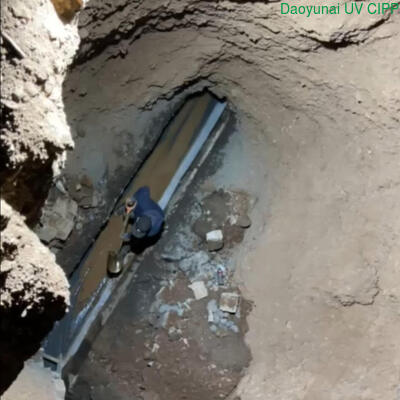
Based on site inspection and evaluation, a severe structural defect exists in the underground pipeline section extending approximately 5 meters from the inspection well: the upper part of the pipeline has completely collapsed, leaving no original soil cover.
Conventional UV-CIPP repair requires the original pipeline to have a certain structure to support the liner. Under the current extreme condition of "no pipe crown, no soil cover," if standard pressure is directly applied for inflation, the liner will over-expand in the unconstrained collapsed area, leading to wall thinning or even bursting, failing to form properly. Therefore, specific special construction techniques must be adopted.
Core Strategy and Process Innovation
To solve the above challenges, this plan adopts an innovative combined process of "Temporary External Constraint + Stepped Air Pressure and Coordinated Backfilling":
Full Wrapping with Safety Caps
Customize and use safety caps over 5 meters long to sheath the exposed UV-CIPP liner, artificially creating a high-strength "temporary physical pipe shell" to restrict the infinite radial expansion of the liner and shape the initial pipe form.
Dynamic Pressure Control and Coordinated Backfilling
Abandoning the traditional "one-time full inflation" process, a dynamic coordinated operation of "Micro-pressure inflation → Initial backfilling → Stepped pressure increase → Deep backfilling" is adopted. The backfill soil is used in stages to provide the ultimate external mechanical support for the liner.
Detailed Construction Steps
Pre-construction Preparation and Site Clearance
Ensuring deep trench fall prevention and safety protection for personnel, clear debris, sludge, stagnant water, and sharp objects in the collapsed area. Keep the trench bottom flat to prevent scratching the UV-CIPP bottom foil during the pulling and inflation process.
Pulling the Bottom Foil and Liner
Lay the sliding bottom foil from the inspection well according to standard procedures, and then use a winch to slowly pull the UV-CIPP liner into the pipe, ensuring it smoothly passes through the >5-meter collapsed and exposed area.
Installing Extended Safety Caps
In the 5-meter collapsed section, completely sleeve the prepared extended safety caps over the UV liner. Both ends of the safety caps must be effectively overlapped and tightly secured to the intact parts of the original pipeline, ensuring the entire liner in the uncovered area is strictly wrapped to form a continuous diameter constraint.
Stepped Pressurization and Coordinated Backfilling
This step is the absolute core of this plan, directly affecting whether the liner can be safely formed. It must be strictly executed simultaneously as follows:
Phase 1: Initial Micro-pressure Inflation
Start the blower and extremely slowly increase the pressure inside the liner, strictly controlling it between 0.1 - 0.2 Bar. The liner will bulge slightly, showing a basic pipe shape, but due to the minimal pressure, it will not break through the safety caps or deform excessively.
Phase 2: Initial Soil Backfilling
While maintaining the 0.1-0.2 Bar micro-pressure, backfill selected soil to the sides and top of the liner in the collapsed area. Backfilling must be done manually and gently; mechanical violent dumping is strictly prohibited. The soil should just cover the sidewalls of the liner, providing initial external support.
Phase 3: Slow Pressure Increase and Synchronized Backfilling
As the first batch of backfill soil provides external support, operators slowly increase the inflation pressure (gradually to 0.3-0.4 Bar or higher), while the construction team continues to pile up the backfill soil. Pressure elevation and soil backfilling are performed alternately and synchronously to maintain a dynamic balance between internal and external forces.
Phase 4: Reaching Working Pressure and Complete Backfilling
When the backfill soil reaches the design elevation above the pipe crown, sufficient to completely resist internal pressure, finally increase the pressure to the standard UV curing working pressure for that pipe diameter. Complete the final compaction of the soil under the balance of internal and external pressure.
UV Curing Operation
After confirming stable pressure and adequate external backfilling, insert the UV light train into the liner. Under standard working pressure, pull the light train at a constant speed calculated based on pipe diameter and wall thickness to perform the UV irradiation curing operation.
End Processing and Restoration
After curing, slowly depressurize, cut off the excess liner at both ends, and remove the safety cap residues at the pipe openings. Use special sealing materials to waterproof and seal the ends at the inspection wells, clean the site, and complete the overall repair project.
Quality Control and Safety Precautions
Pressure Monitoring
Dedicated personnel must monitor the pressure gauge throughout the inflation process, and highly sensitive safety relief valves must be equipped. Blindly increasing pressure before backfilling is in place is absolutely prohibited.
Strict Backfill Material Control
Backfill soil must be fine soil or medium-coarse sand. Sharp debris such as large stones, concrete blocks, and scrap rebar is strictly prohibited to prevent piercing the safety caps and liner.
Trench Work Safety
The trench in the collapsed area is deep. When backfilling and sleeving, deep excavation anti-collapse shoring must be implemented to ensure the safety of the operating personnel.
UV-CIPP pipeline repair construction site showing trench safety measures and equipment setup
Products
PRODUCTS DETAILS
UV-CIPP Repair for Partially Collapsed Pipeline Without Soil Cover Using Temporary External Constraint
MOQ: 1 set
Price: Variable
Standard Packaging: Normal
Delivery Period: 10 working days
Payment Method: T/T
Supply Capacity: 100 sets per year
Detail Information
Place of Origin
China
Brand Name
CIPPTECH
Certification
ISO
Model Number
D9
Minimum Order Quantity:
1 set
Price:
Variable
Packaging Details:
Normal
Delivery Time:
10 working days
Payment Terms:
T/T
Supply Ability:
100 sets per year
Highlight

Partially Collapsed Pipeline Repair UV-CIPP Repair

,

Without Soil Cover Trenchless Pipeline Repair

,

Temporary External Constraint No-Dig Pipeline Rehabilitation

Product Description
Special Construction Plan for UV-CIPP Repair of Partially Collapsed Pipeline (Without Soil Cover)
Project Overview and Special Condition Analysis
Based on site inspection and evaluation, a severe structural defect exists in the underground pipeline section extending approximately 5 meters from the inspection well: the upper part of the pipeline has completely collapsed, leaving no original soil cover.
Conventional UV-CIPP repair requires the original pipeline to have a certain structure to support the liner. Under the current extreme condition of "no pipe crown, no soil cover," if standard pressure is directly applied for inflation, the liner will over-expand in the unconstrained collapsed area, leading to wall thinning or even bursting, failing to form properly. Therefore, specific special construction techniques must be adopted.
Core Strategy and Process Innovation
To solve the above challenges, this plan adopts an innovative combined process of "Temporary External Constraint + Stepped Air Pressure and Coordinated Backfilling":
Full Wrapping with Safety Caps
Customize and use safety caps over 5 meters long to sheath the exposed UV-CIPP liner, artificially creating a high-strength "temporary physical pipe shell" to restrict the infinite radial expansion of the liner and shape the initial pipe form.
Dynamic Pressure Control and Coordinated Backfilling
Abandoning the traditional "one-time full inflation" process, a dynamic coordinated operation of "Micro-pressure inflation → Initial backfilling → Stepped pressure increase → Deep backfilling" is adopted. The backfill soil is used in stages to provide the ultimate external mechanical support for the liner.
Detailed Construction Steps
Pre-construction Preparation and Site Clearance
Ensuring deep trench fall prevention and safety protection for personnel, clear debris, sludge, stagnant water, and sharp objects in the collapsed area. Keep the trench bottom flat to prevent scratching the UV-CIPP bottom foil during the pulling and inflation process.
Pulling the Bottom Foil and Liner
Lay the sliding bottom foil from the inspection well according to standard procedures, and then use a winch to slowly pull the UV-CIPP liner into the pipe, ensuring it smoothly passes through the >5-meter collapsed and exposed area.
Installing Extended Safety Caps
In the 5-meter collapsed section, completely sleeve the prepared extended safety caps over the UV liner. Both ends of the safety caps must be effectively overlapped and tightly secured to the intact parts of the original pipeline, ensuring the entire liner in the uncovered area is strictly wrapped to form a continuous diameter constraint.
Stepped Pressurization and Coordinated Backfilling
This step is the absolute core of this plan, directly affecting whether the liner can be safely formed. It must be strictly executed simultaneously as follows:
Phase 1: Initial Micro-pressure Inflation
Start the blower and extremely slowly increase the pressure inside the liner, strictly controlling it between 0.1 - 0.2 Bar. The liner will bulge slightly, showing a basic pipe shape, but due to the minimal pressure, it will not break through the safety caps or deform excessively.
Phase 2: Initial Soil Backfilling
While maintaining the 0.1-0.2 Bar micro-pressure, backfill selected soil to the sides and top of the liner in the collapsed area. Backfilling must be done manually and gently; mechanical violent dumping is strictly prohibited. The soil should just cover the sidewalls of the liner, providing initial external support.
Phase 3: Slow Pressure Increase and Synchronized Backfilling
As the first batch of backfill soil provides external support, operators slowly increase the inflation pressure (gradually to 0.3-0.4 Bar or higher), while the construction team continues to pile up the backfill soil. Pressure elevation and soil backfilling are performed alternately and synchronously to maintain a dynamic balance between internal and external forces.
Phase 4: Reaching Working Pressure and Complete Backfilling
When the backfill soil reaches the design elevation above the pipe crown, sufficient to completely resist internal pressure, finally increase the pressure to the standard UV curing working pressure for that pipe diameter. Complete the final compaction of the soil under the balance of internal and external pressure.
UV Curing Operation
After confirming stable pressure and adequate external backfilling, insert the UV light train into the liner. Under standard working pressure, pull the light train at a constant speed calculated based on pipe diameter and wall thickness to perform the UV irradiation curing operation.
End Processing and Restoration
After curing, slowly depressurize, cut off the excess liner at both ends, and remove the safety cap residues at the pipe openings. Use special sealing materials to waterproof and seal the ends at the inspection wells, clean the site, and complete the overall repair project.
Quality Control and Safety Precautions
Pressure Monitoring
Dedicated personnel must monitor the pressure gauge throughout the inflation process, and highly sensitive safety relief valves must be equipped. Blindly increasing pressure before backfilling is in place is absolutely prohibited.
Strict Backfill Material Control
Backfill soil must be fine soil or medium-coarse sand. Sharp debris such as large stones, concrete blocks, and scrap rebar is strictly prohibited to prevent piercing the safety caps and liner.
Trench Work Safety
The trench in the collapsed area is deep. When backfilling and sleeving, deep excavation anti-collapse shoring must be implemented to ensure the safety of the operating personnel.
UV-CIPP pipeline repair construction site showing trench safety measures and equipment setup
Sitemap |  Privacy Policy | China Good Quality UV CIPP Equipment Supplier. Copyright © 2022-2026 Daoyunai Energy Saving Technology Limited . All Rights Reserved.